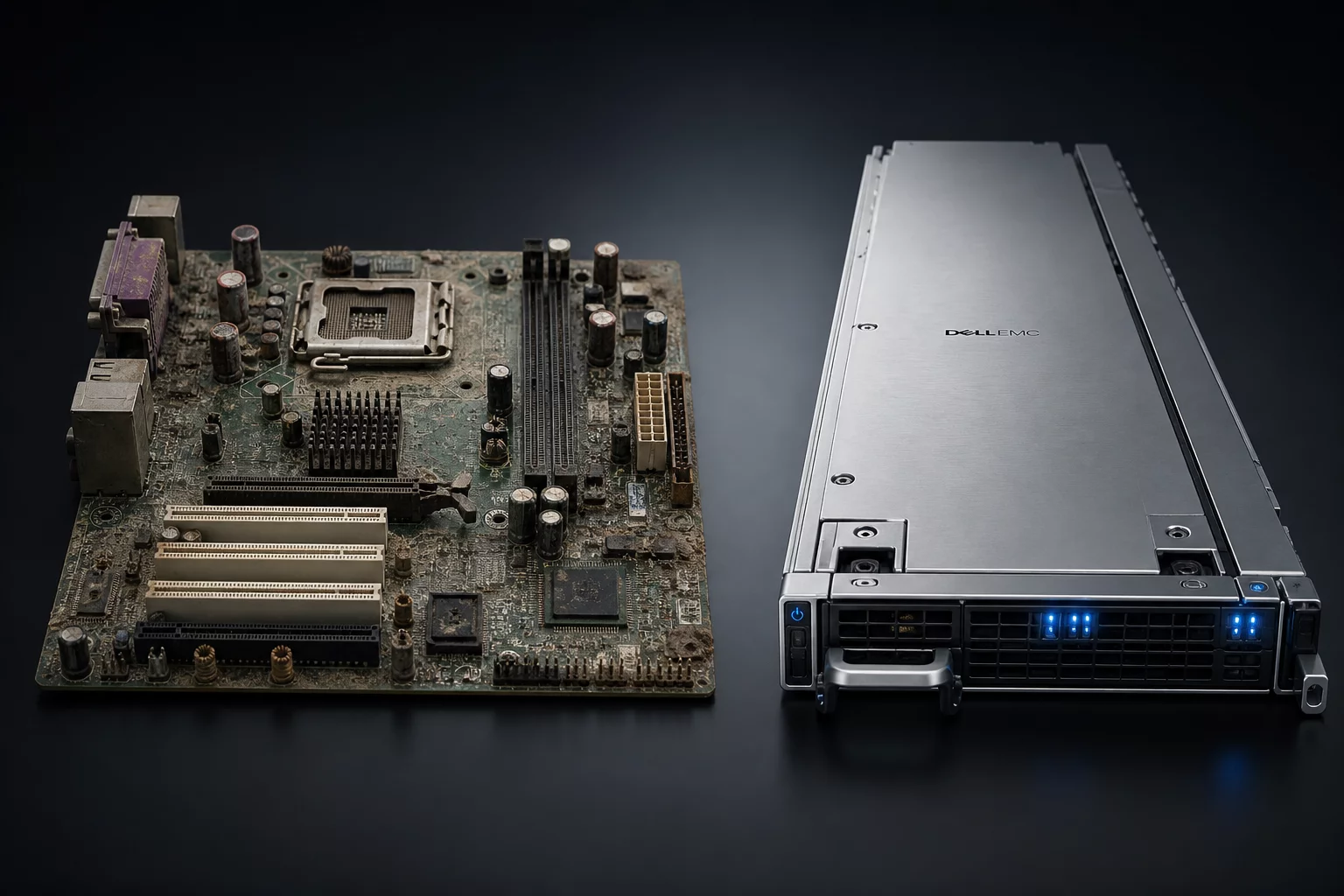
The Abrupt Discontinuation of Legacy Silicon
Production systems running on legacy generation enterprise servers often carry hidden dependencies on proprietary host bus adapters, storage controllers, and legacy chipset microcode. When the primary database chassis suffered catastrophic backplane failure during an unseasonal power surge, the replacement unit sourced through emergency vendor channels arrived with an updated chipset revision. What appeared to be an identical server model contained an incompatible PCIe bridge topology that refused to initialize the legacy storage volume containing five years of transaction journals.
The engineering team immediately realized that standard bare-metal restore images lacked kernel drivers for the newly deployed storage subsystem. While the cold backup image sat safely on the network repository, the destination machine threw kernel panic loops upon encountering unfamiliar driver signatures during bootloader execution.
Root Failure Analysis
Relying on bare-metal backups without verifying hardware abstraction or maintaining cold-standby hardware of matching hardware generations turns unexpected physical hardware failures into unmanageable platform migration crises.
The Physical-to-Virtual Translation Pivot
Faced with an indefinite lead time for legacy replacement parts, the recovery lead ordered a physical-to-virtual (P2V) translation. The team extracted raw sector images into VHDX virtual disks, injected generalized synthetic storage drivers, and spun up the instance inside a temporary hypervisor environment.
Sequence of Incidents
The critical path sequence from initial hardware seizure through virtual abstraction injection and eventual service validation.
- 02:15 UTC — Catastrophic hardware failure on primary storage chassis; vendor confirms legacy motherboard revision is out of production.
- 05:40 UTC — Replacement chassis fails boot diagnostics due to missing SAS controller drivers inside the legacy OS kernel image.
- 11:30 UTC — Raw disk image conversion to synthetic virtual disk format completes; hypervisor boots with generalized VirtIO storage drivers.
Corrective Infrastructure Steps
Automated injection script used to slipstream universal kernel storage drivers into mounted offline raw sector images prior to hypervisor provisioning.
virt-v2v -i disk /var/lib/images/legacy-db-raw.img -o local -os /var/lib/vm-storage -of qcow2 --bridge virbr0 --root-path /dev/sda1
Post-Restore Validation Criteria
Essential operational criteria verified prior to opening ingress ports to production application traffic.
- Storage subsystem I/O queue latency sustained below 8ms under synthetic load benchmarks.
- All legacy physical MAC addresses mapped to synthetic virtual switch adapters with proper VLAN tags.
- Database integrity checks (DBCC CHECKDB / fsck) returned zero corrupt sectors or broken allocation chains.
Architectural Vulnerabilities and Preventive Design
Bare-metal hardware binds your operational recovery timeline directly to manufacturer supply chains. Decoupling the operating environment from specific silicon, implementing virtualized cold standbys, and routinely testing recovery on dissimilar hardware are essential steps to avoid obsolescence traps during emergency recovery operations.
Technical Discussion
Peer review and sysadmin engineering remarks
Hardware lifecycle audits must include cold restore dry-runs against newer server generations. Testing bare-metal backups solely against identical spares gives a false sense of security that shatters the moment suppliers drop vendor support.
Submit Technical Response
Share post-mortem observations or query specific diagnostic parameters.
The automated failover diagnostics drastically reduced our incident recovery window. Replacing brittle shell scripts with the telemetry playbook isolated memory leaks in our Kubernetes cluster in under four minutes.
STATUS 200 OK • LATENCY: 14ms • ROOT_CAUSE: OOM_KILLER_EVACUATED